A salary slip (also called a payslip or pay slip) is the monthly statement an employer gives an employee showing what they earned, what was deducted, and the final amount paid into their bank account. If you run a small business, a shop or a startup and still write salaries in a notebook, a proper salary slip format saves you arguments, helps your staff get loans and visas, and keeps your records clean for audits.
Below you’ll find every component explained in simple words, a sample salary slip, and a free Excel salary slip template that calculates gross pay, PF, ESI and net pay automatically.
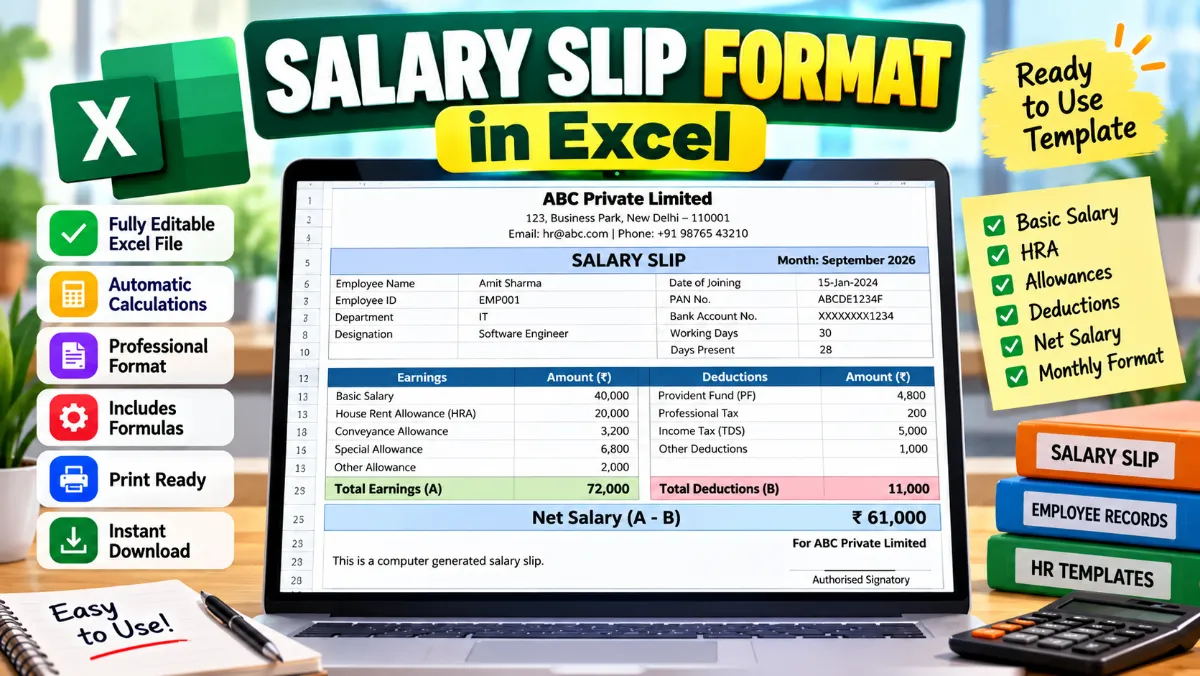
Free download: Salary Slip Format in Excel (.xlsx)
Ready-made, editable payslip with formulas for gross earnings, loss-of-pay days, PF, ESI, professional tax and net pay. Just fill in the yellow cells.
What should a salary slip contain?
A complete salary slip has four parts:
- Company details: company name, address and the month the slip is for.
- Employee details: name, employee ID, designation, department, date of joining, PAN, UAN/PF number and bank account (last 4 digits only).
- Attendance: days in the month, paid days and loss-of-pay (LOP) days.
- Earnings, deductions and net pay: the money part, explained below.
Earnings: what each component means
| Component | What it is |
|---|---|
| Basic salary | The fixed core of the salary. PF and gratuity are calculated on it. Under India’s new labour codes, wages (basic + DA) are expected to be at least 50% of total pay, so keep basic high enough. |
| Dearness allowance (DA) | An inflation adjustment, common in government and some private jobs. Many small businesses keep this at zero. |
| House rent allowance (HRA) | Paid to help with rent. Employees who live on rent can claim part of it as tax-exempt under the old tax regime. |
| Conveyance / travel allowance | For travel between home and office. |
| Special allowance | A balancing figure that makes up the rest of the agreed salary. |
| Bonus / incentive | Performance pay, festival bonus or sales commission for that month. |
Deductions: what gets cut and why
| Deduction | How it works |
|---|---|
| Provident fund (PF / EPF) | Employee contributes 12% of basic + DA. It’s mandatory on wages up to ₹15,000 a month; many employers contribute on the full basic. The employer adds a matching 12% (split between EPF and pension), which usually isn’t shown as a deduction. |
| ESI | Applies when gross salary is ₹21,000 a month or less. Employee pays 0.75% of gross; employer pays 3.25%. |
| Professional tax (PT) | A state tax on employment, capped at ₹2,500 a year. The monthly amount depends on your state, and some states don’t charge it at all. |
| Income tax (TDS) | Tax deducted at source based on the employee’s expected yearly income and the tax regime they chose. |
| Advance / loan recovery | Any salary advance being paid back in instalments. |
Sample salary slip
Here’s how a salary slip looks for an employee on ₹45,000 a month with full attendance:
| Earnings | ₹ | Deductions | ₹ |
|---|---|---|---|
| Basic salary | 25,000 | PF (12% of ₹15,000 ceiling) | 1,800 |
| HRA | 10,000 | ESI (not applicable above ₹21,000) | 0 |
| Conveyance | 1,600 | Professional tax | 200 |
| Special allowance | 8,400 | TDS | 0 |
| Gross earnings | 45,000 | Total deductions | 2,000 |
| Net pay | 43,000 | ||
This is exactly what the free Excel template above produces with its sample numbers. Change them and every total updates.
How to calculate net salary
- Add all earnings to get gross salary for a full month.
- Adjust for leave without pay: gross × paid days ÷ days in month.
- Add all deductions (PF, ESI, PT, TDS, recoveries).
- Net pay = gross earnings − total deductions.
How to use the free Excel template
- Replace the company name and address at the top.
- Fill in the yellow cells: employee details, paid days and each earning.
- PF, ESI, totals and net pay calculate themselves. Set professional tax for your state.
- Save one copy per employee per month, or print to PDF and send it on WhatsApp or email.
Need offer letters, appointment letters, attendance sheets and invoices too?
The 4000+ HR, Business & Accounts Format Toolkit has ready-made Word and Excel formats for almost every office document, so you never start from a blank page.
Frequently asked questions
Is it compulsory to give a salary slip?
Employers covered by labour laws are expected to issue wage slips, and the new labour codes reinforce this. Even where it isn’t strictly required, a payslip protects both sides and employees need it for loans, rental agreements and visas.
Can I make a salary slip in Excel?
Yes. Excel is the easiest way for small businesses. Use the free template above, which has the formulas already set up.
Why is my PF only ₹1,800 when 12% of my basic is more?
PF is mandatory only on wages up to ₹15,000 a month, and 12% of ₹15,000 is ₹1,800. Your employer may choose to contribute on the full basic instead.
What is LOP on a salary slip?
LOP means loss of pay: days of unpaid leave or absence. Salary is reduced in proportion to those days.
This guide is for general information. Rules for PF, ESI, professional tax and TDS can change and differ by state, so check with your accountant for your business.